Builds on: How can I trust the actions I take in simulations? › How does an action enter a simulation? › What makes an action good? › What if I can only partly observe the system? › How can a simulation be wrong?
How sensitive is my action to the simulation?
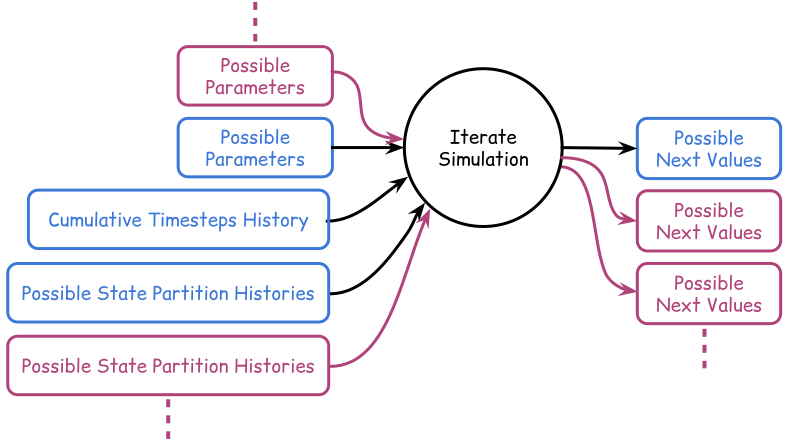
When we change the parameters of a simulation, its iteration at the same point in time may produce different outcomes, depending on the system state and its history (which may also have changed due to previous iterations in time being different).
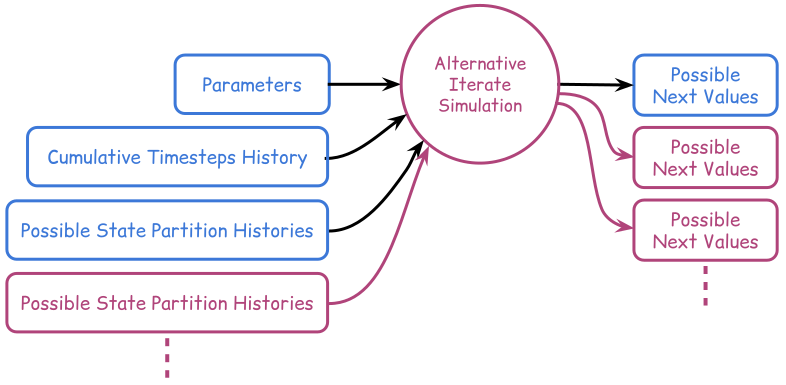
Similarly, when we change the simulation itself, its iteration at the same point in time may also produce different outcomes.
In both cases, the simulated outcomes help us to determine which action to take, but in order to do this we need to define what outcomes we are targeting in the first place.
References and further reading
Hardwick, Robert J. 2026a. “How can a simulation be wrong?” umbralcalculations, August. https://umbralcalc.github.io/posts/how_can_a_simulation_be_wrong.html.
Hardwick, Robert J. 2026b. “Is a sloppy simulation a bad one?” umbralcalculations, November. https://umbralcalc.github.io/posts/is_a_sloppy_simulation_a_bad_one.html.
Saltelli, Andrea, Ksenia Aleksankina, William Becker, et al. 2019. “Why so Many Published Sensitivity Analyses Are False: A Systematic Review of Sensitivity Analysis Practices.” Environmental Modelling & Software 114: 29–39. https://doi.org/10.1016/j.envsoft.2019.01.012.
Sobol’, Ilya M. 2001. “Global Sensitivity Indices for Nonlinear Mathematical Models and Their Monte Carlo Estimates.” Mathematics and Computers in Simulation 55 (1–3): 271–80. https://doi.org/10.1016/S0378-4754(00)00270-6.
Questions whose answers cite this one