From root: Why should I simulate the real world?
Is a sloppy simulation a bad one?
Not necessarily, and often the opposite. Once a simulation can learn its parameters from real-world data, a natural next question is how sensitive the simulation-data fit is to changes in those parameters. In other words, how sloppy is the simulation?
If a simulation is sloppy it means that it has many additional parameters which can be varied that do not strongly affect the quality of fit to the dataset of interest. We typically call this kind of parameter ‘unconstrained’ by the data.
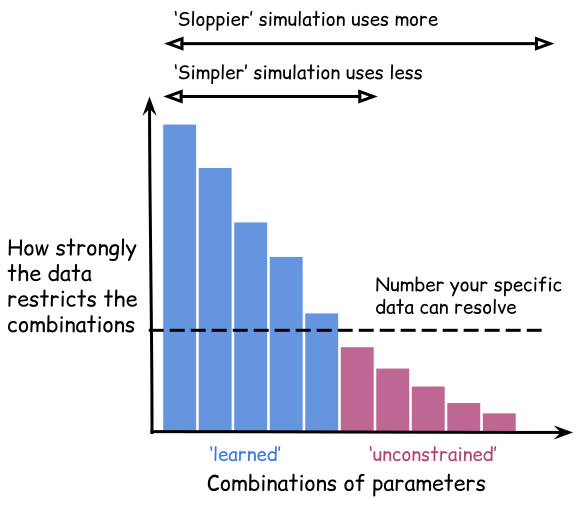
Simulation sloppiness sounds bad; but it has been shown that machine learning models with more sloppiness have a tendency to generalise better to new datasets.
References and further reading
Gutenkunst, Ryan N., Joshua J. Waterfall, Fergal P. Casey, Kevin S. Brown, Christopher R. Myers, and James P. Sethna. 2007. “Universally Sloppy Parameter Sensitivities in Systems Biology Models.” PLoS Computational Biology 3 (10): 1871–78. https://doi.org/10.1371/journal.pcbi.0030189.
Hardwick, Robert J. 2026a. “How does a simulation learn its parameters from data?” umbralcalculations, November. https://umbralcalc.github.io/posts/how_does_a_simulation_learn_its_parameters_from_data.html.
Hardwick, Robert J. 2026b. “Why should I simulate the real world?” umbralcalculations, May. https://umbralcalc.github.io/posts/why_should_i_simulate_the_real_world.html.
Mao, Jialin, Itay Griniasty, Yan Sun, Mark K. Transtrum, James P. Sethna, and Pratik Chaudhari. 2025. An Analytical Characterization of Sloppiness in Neural Networks: Insights from Linear Models. arXiv preprint. https://arxiv.org/abs/2505.08915.
Mao, Jialin, Itay Griniasty, Han Kheng Teoh, et al. 2024. “The Training Process of Many Deep Networks Explores the Same Low-Dimensional Manifold.” Proceedings of the National Academy of Sciences 121: e2310002121. https://doi.org/10.1073/pnas.2310002121.
Sethna, James P. 2024. “Sloppy Models, Information Geometry, and Emergent Simplicity.” Cornell University. https://sethna.lassp.cornell.edu/Teaching/BasicTraining/SloppyBT24.html.
Transtrum, Mark K., Benjamin B. Machta, Kevin S. Brown, Bryan C. Daniels, Christopher R. Myers, and James P. Sethna. 2015. “Perspective: Sloppiness and Emergent Theories in Physics, Biology, and Beyond.” The Journal of Chemical Physics 143 (1): 010901. https://doi.org/10.1063/1.4923066.
Questions whose answers cite this one