Through a model that maps estimated statistics back onto probabilities of state values. Once we have the statistics, where have the probabilities gone?
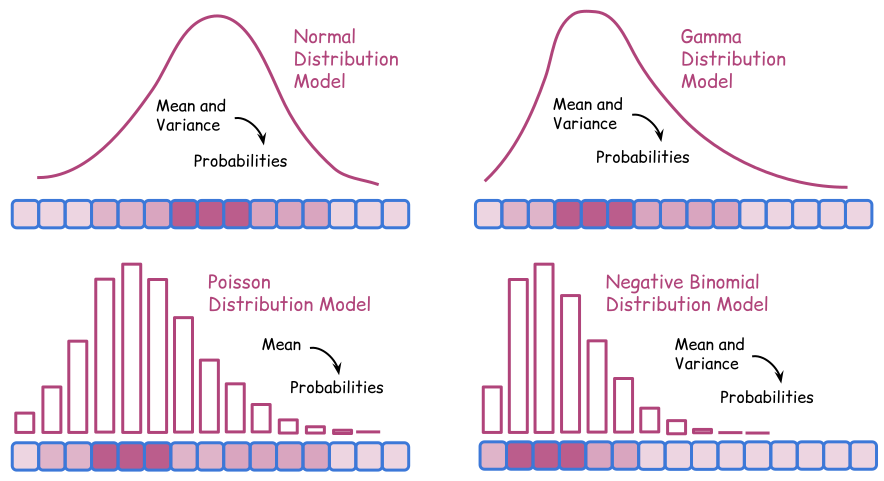
There are many different types of mathematical formulae or machine learning model which can provide a map back from these estimated statistics into probabilities of state values in time for either one or multiple trajectories, depending on the right circumstances.
Using calculations of the estimated statistics for a single trajectory from the state partition history, we can design a ‘probabilistic sample weighting’ algorithm which compresses the information held within the state partition history into a small amount of data (the statistics).
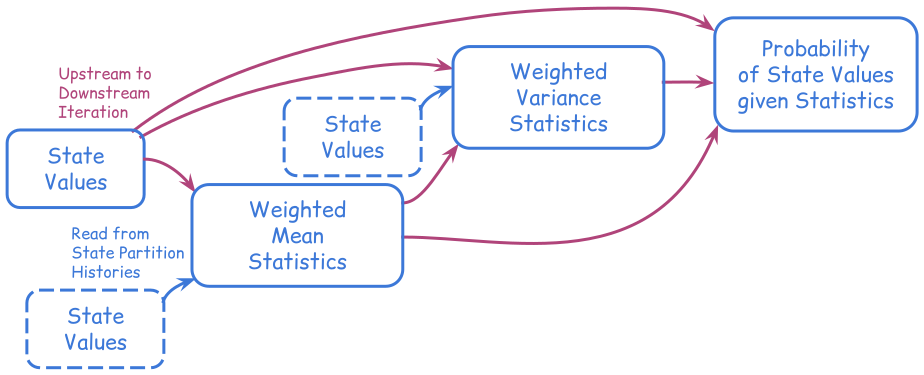
We can then use these statistics to calculate estimated probabilities for any possible state value in time.
Doucet, Arnaud, and Adam M. Johansen. 2011. “A Tutorial on Particle Filtering and Smoothing: Fifteen Years Later.” In The Oxford Handbook of Nonlinear Filtering, edited by Dan Crisan and Boris Rozovskii. Oxford University Press.
Hardwick, Robert J. 2026a.
“Can one trajectory be enough to estimate statistics?” umbralcalculations, November.
https://umbralcalc.github.io/posts/can_one_trajectory_be_enough_to_estimate_statistics.html.
Hardwick, Robert J. 2026b.
“How do we estimate statistics across trajectories?” umbralcalculations, November.
https://umbralcalc.github.io/posts/how_do_we_estimate_statistics_across_trajectories.html.
Hardwick, Robert J. 2026c.
“Why should I simulate the real world?” umbralcalculations, May.
https://umbralcalc.github.io/posts/why_should_i_simulate_the_real_world.html.
Särkkä, Simo. 2013.
Bayesian Filtering and Smoothing. Cambridge University Press.
https://doi.org/10.1017/CBO9781139344203.