From root: Why should I simulate the real world?
How do we estimate statistics across trajectories?
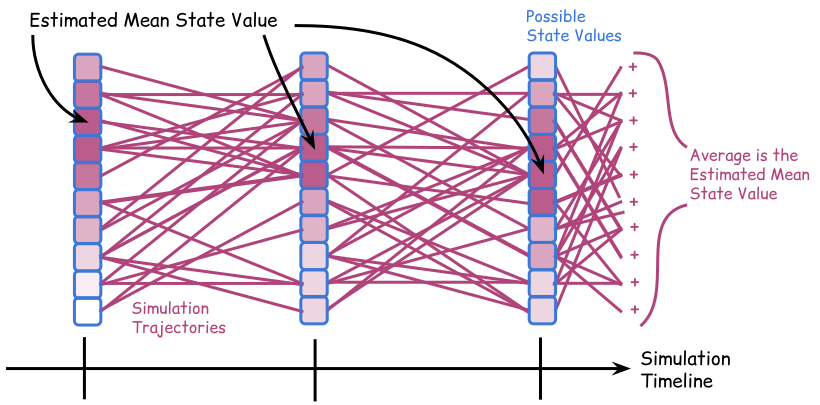
By averaging over many simulation runs, timestep by timestep. There is a way to get at the probabilities of state values without tracing the path of every possible trajectory, and often without keeping a record of every possible state value.
We start by estimating the statistics of these probabilities.
The simplest example of these statistics is the estimated mean state value.
The obvious way to calculate this is to take the average state value for a given timestep across multiple simulation trajectories.
But could we get an estimate of statistics from only one trajectory to avoid all the additional computations?
References and further reading
Hardwick, Robert J. 2025. “Why think about a simulation probabilistically?” umbralcalculations, November. https://umbralcalc.github.io/posts/why_think_about_a_simulation_probabilistically.html.
Hardwick, Robert J. 2026. “Why should I simulate the real world?” umbralcalculations, May. https://umbralcalc.github.io/posts/why_should_i_simulate_the_real_world.html.
Owen, Art B. 2013. Monte Carlo Theory, Methods and Examples. https://artowen.su.domains/mc/.
Questions whose answers cite this one