From root: Why should I simulate the real world?
Can one trajectory be enough to estimate statistics?
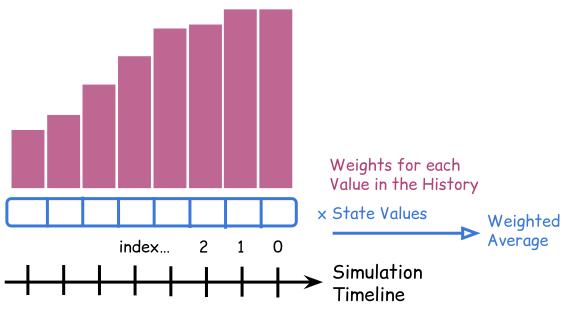
Yes! If we have an accurate ‘weighting model’ for the past values, we can get an estimated mean state value from a weighted average over the full state partition history.
Many trajectories
Average across multiple simulation runs.
Weighted state partition history
One trajectory with recency weights.
We might also train a machine learning model to predict the statistics of state values from the full state partition history as an alternative.
Note that there are situations where using the state partition histories from one trajectory is not equivalent to using multiple trajectories (see ergodicity). But this kind of technical problem can often be mitigated by using some mix of the two methods.
References and further reading
Doucet, Arnaud, and Adam M. Johansen. 2011. “A Tutorial on Particle Filtering and Smoothing: Fifteen Years Later.” In The Oxford Handbook of Nonlinear Filtering, edited by Dan Crisan and Boris Rozovskii. Oxford University Press.
Gordon, Neil J., David J. Salmond, and Adrian F. M. Smith. 1993. “Novel Approach to Nonlinear/Non-Gaussian Bayesian State Estimation.” IEE Proceedings F (Radar and Signal Processing) 140 (2): 107–13. https://doi.org/10.1049/ip-f-2.1993.0015.
Hardwick, Robert J. 2026a. “How do we estimate statistics across trajectories?” umbralcalculations, November. https://umbralcalc.github.io/posts/how_do_we_estimate_statistics_across_trajectories.html.
Hardwick, Robert J. 2026b. “Why should I simulate the real world?” umbralcalculations, May. https://umbralcalc.github.io/posts/why_should_i_simulate_the_real_world.html.
Wikipedia contributors. n.d. “Ergodicity.” Wikipedia. https://en.wikipedia.org/wiki/Ergodicity.
Questions whose answers cite this one