From root: Why should I simulate the real world?
Can a simulation learn as the data arrives?
Yes, by updating its parameter estimates each time a new data point arrives rather than refitting to the whole batch. The data probabilities of simulation trajectories can be interpreted as probabilities of simulation parameters, often accompanied by some simulation noise to account for differences between trajectories even with the same parameters.
We can create an algorithm which uses this sequence of probabilities to estimate the probabilities of simulation parameters in a very similar way to probabilistic sample weighting.
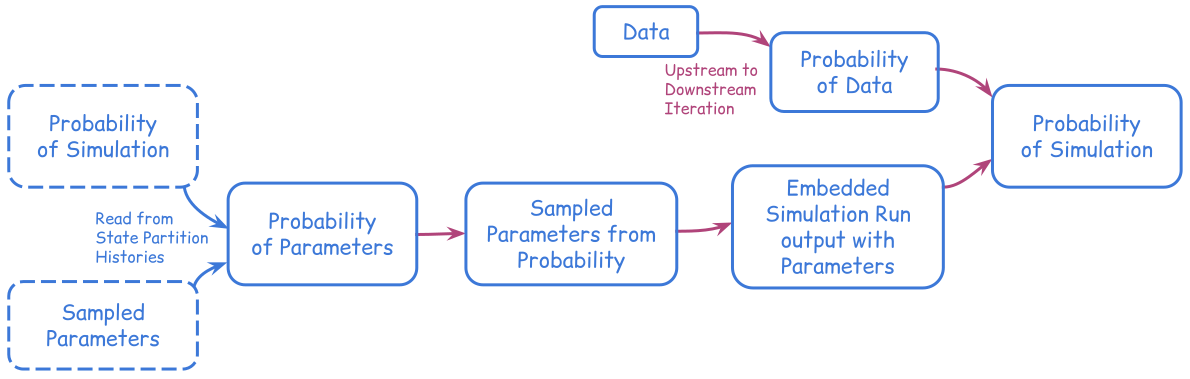
We might call this algorithm ‘online simulation parameter estimation’; where ‘online’ here means that the simulation is being adaptively learned to the data iteratively in time, as opposed to a whole batch all at once.
Observed data vs estimated trajectory
Parameter posterior estimate
Each bar estimates how plausible a particular θ value is given the data.
References and further reading
Doucet, Arnaud, and Adam M. Johansen. 2011. “A Tutorial on Particle Filtering and Smoothing: Fifteen Years Later.” In The Oxford Handbook of Nonlinear Filtering, edited by Dan Crisan and Boris Rozovskii. Oxford University Press.
Gordon, Neil J., David J. Salmond, and Adrian F. M. Smith. 1993. “Novel Approach to Nonlinear/Non-Gaussian Bayesian State Estimation.” IEE Proceedings F (Radar and Signal Processing) 140 (2): 107–13. https://doi.org/10.1049/ip-f-2.1993.0015.
Hardwick, Robert J. 2026a. “Can one trajectory be enough to estimate statistics?” umbralcalculations, November. https://umbralcalc.github.io/posts/can_one_trajectory_be_enough_to_estimate_statistics.html.
Hardwick, Robert J. 2026b. “How does a simulation learn its parameters from data?” umbralcalculations, November. https://umbralcalc.github.io/posts/how_does_a_simulation_learn_its_parameters_from_data.html.
Hardwick, Robert J. 2026c. “Why should I simulate the real world?” umbralcalculations, May. https://umbralcalc.github.io/posts/why_should_i_simulate_the_real_world.html.
Questions whose answers cite this one