From root: Why should I simulate the real world?
What objective does a simulation learn against?
One we design ourselves, which either scores how closely the simulation replicates data or names the quantity we want to optimise.
Unlike machine learning models, which typically come with standard training algorithms (like backpropagation for neural networks), simulations often need us to explicitly choose and design procedures for learning their parameters from real-world data or optimising their outputs.
In order to do this, we must first have some objective which either characterises how close simulation trajectories are to replicating the data we have or define the quantity we want to optimise.
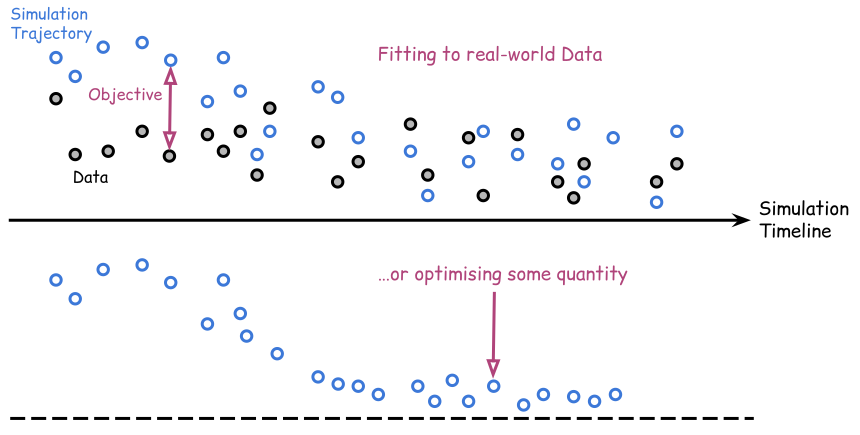
There are a number of techniques we can use to specify what the objective should be, depending on the purpose.
References and further reading
Cranmer, Kyle, Johann Brehmer, and Gilles Louppe. 2020. “The Frontier of Simulation-Based Inference.” Proceedings of the National Academy of Sciences 117 (48): 30055–62. https://doi.org/10.1073/pnas.1912789117.
Hardwick, Robert J. 2026a. “How do we get probabilities back from statistics?” umbralcalculations, November. https://umbralcalc.github.io/posts/how_do_we_get_probabilities_back_from_statistics.html.
Hardwick, Robert J. 2026b. “Why should I simulate the real world?” umbralcalculations, May. https://umbralcalc.github.io/posts/why_should_i_simulate_the_real_world.html.
Wikipedia contributors. n.d. “Backpropagation.” Wikipedia. https://en.wikipedia.org/wiki/Backpropagation.
Questions whose answers cite this one