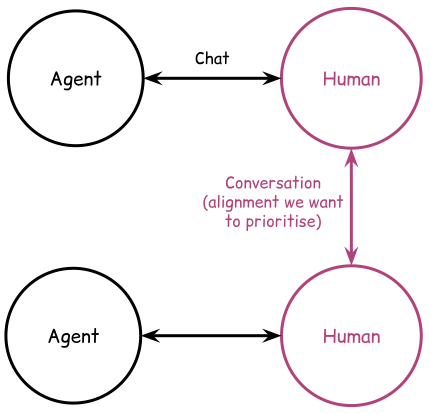
We build systems of agent-human interaction which prioritise human alignment, but what does this this mean in practice?
Humans must now align more than just themselves with others, they may also have to align with the agents which others chat to, as well as their own.
This increased size of the system with siloed chat threads makes alignment between humans more difficult in principle, because there are simply more components to it and not all of them have direct paths to communicate to one-another.
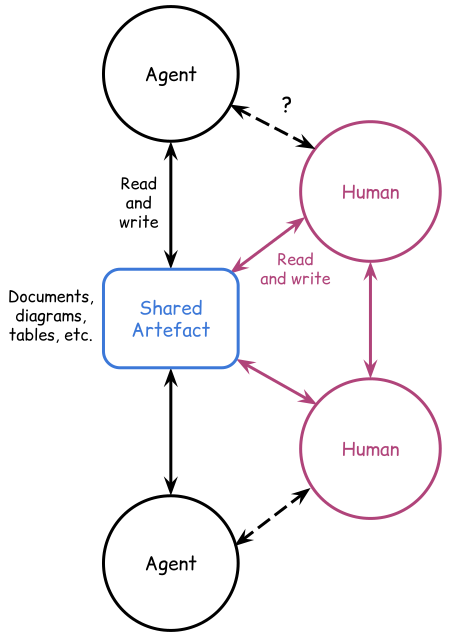
To resolve this issue, we can draw experience from how humans aligned before AI. We can introduce shared artefacts such as diagrams and documents that all components of the system must interact and align over.
Communication would still occur between all components of the system, however, their tendencies to reach misaligned outcomes are controlled through this artefact. Perhaps we should be designing applications this way?
Amershi, Saleema, Dan Weld, Mihaela Vorvoreanu, et al. 2019.
“Guidelines for Human-AI Interaction.” Proceedings of the 2019 CHI Conference on Human Factors in Computing Systems, 1–13.
https://doi.org/10.1145/3290605.3300233.
Bavelas, Alex. 1950.
“Communication Patterns in Task-Oriented Groups.” The Journal of the Acoustical Society of America 22 (6): 725–30.
https://doi.org/10.1121/1.1906679.
Carlile, Paul R. 2002.
“A Pragmatic View of Knowledge and Boundaries: Boundary Objects in New Product Development.” Organization Science 13 (4): 442–55.
https://doi.org/10.1287/orsc.13.4.442.2953.
Clark, Herbert H., and Susan E. Brennan. 1991.
“Grounding in Communication.” In
Perspectives on Socially Shared Cognition, edited by Lauren B. Resnick, John M. Levine, and Stephanie D. Teasley. American Psychological Association.
https://doi.org/10.1037/10096-006.
Dafoe, Allan, Yoram Bachrach, Gillian Hadfield, Eric Horvitz, Kate Larson, and Thore Graepel. 2021.
“Cooperative AI: Machines Must Learn to Find Common Ground.” Nature 593 (7857): 33–36.
https://doi.org/10.1038/d41586-021-01170-0.
Doshi, Anil R., and Oliver P. Hauser. 2024.
“Generative AI Enhances Individual Creativity but Reduces the Collective Diversity of Novel Content.” Science Advances 10 (28): eadn5290.
https://doi.org/10.1126/sciadv.adn5290.
Hancock, Jeffrey T., Mor Naaman, and Karen Levy. 2020.
“AI-Mediated Communication: Definition, Research Agenda, and Ethical Considerations.” Journal of Computer-Mediated Communication 25 (1): 89–100.
https://doi.org/10.1093/jcmc/zmz022.
Hardwick, Robert J. 2026a.
“Is black box AI an accelerator?” umbralcalculations, November.
https://umbralcalc.github.io/posts/is_black_box_ai_an_accelerator.html.
Hardwick, Robert J. 2026b.
“Is there a structure to agent-accelerated work?” umbralcalculations, November.
https://umbralcalc.github.io/posts/is_there_a_structure_to_agent_accelerated_work.html.
Heylighen, Francis. 2016.
“Stigmergy as a Universal Coordination Mechanism I: Definition and Components.” Cognitive Systems Research 38: 4–13.
https://doi.org/10.1016/j.cogsys.2015.12.002.
Jakesch, Maurice, Advait Bhat, Daniel Buschek, Lior Zalmanson, and Mor Naaman. 2023.
“Co-Writing with Opinionated Language Models Affects Users’ Views.” Proceedings of the 2023 CHI Conference on Human Factors in Computing Systems, 1–15.
https://doi.org/10.1145/3544548.3581196.
Malone, Thomas W., and Kevin Crowston. 1994.
“The Interdisciplinary Study of Coordination.” ACM Computing Surveys 26 (1): 87–119.
https://doi.org/10.1145/174666.174668.
Mathieu, John E., Tonia S. Heffner, Gerald F. Goodwin, Eduardo Salas, and Janis A. Cannon-Bowers. 2000.
“The Influence of Shared Mental Models on Team Process and Performance.” Journal of Applied Psychology 85 (2): 273–83.
https://doi.org/10.1037/0021-9010.85.2.273.
Schmidt, Kjeld, and Carla Simone. 1996.
“Coordination Mechanisms: Towards a Conceptual Foundation of CSCW Systems Design.” Computer Supported Cooperative Work (CSCW) 5 (2–3): 155–200.
https://doi.org/10.1007/BF00133655.
Sharma, Mrinank, Meg Tong, Tomasz Korbak, et al. 2023.
Towards Understanding Sycophancy in Language Models. arXiv preprint.
https://arxiv.org/abs/2310.13548.
Shneiderman, Ben, and Pattie Maes. 1997.
“Direct Manipulation Vs. Interface Agents.” Interactions 4 (6): 42–61.
https://doi.org/10.1145/267505.267514.
Star, Susan Leigh, and James R. Griesemer. 1989.
“Institutional Ecology, ‘Translations’ and Boundary Objects: Amateurs and Professionals in Berkeley’s Museum of Vertebrate Zoology, 1907–39.” Social Studies of Science 19 (3): 387–420.
https://doi.org/10.1177/030631289019003001.
Stasser, Garold, and William Titus. 1985.
“Pooling of Unshared Information in Group Decision Making: Biased Information Sampling During Discussion.” Journal of Personality and Social Psychology 48 (6): 1467–78.
https://doi.org/10.1037/0022-3514.48.6.1467.
Wattenberger, Amelia. 2023.
“Why Chatbots Are Not the Future.” https://wattenberger.com/thoughts/boo-chatbots.