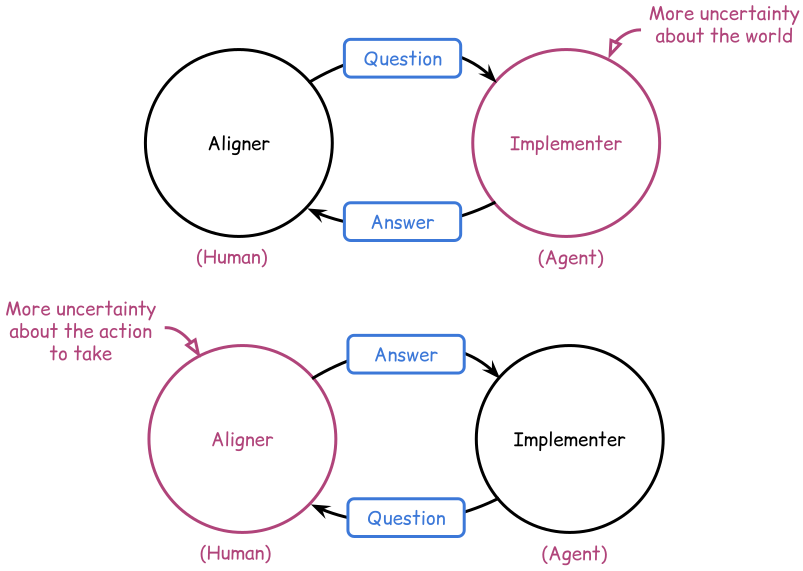
We can separate roles in any piece of work into two distinct categories: the ‘aligner’ and the ‘implementer’. Economists would call these the ‘principal’ and the ‘agent’, but since ‘agent’ is about to mean something else here, we will keep the names above.
The aligner is responsible for what the work the implementer is doing is seeking to accomplish. While this sounds like something static, in reality it is very common for the aligner to adapt short-term goals as more information is learned to keep on track towards a longer-term goal.
The implementer is responsible for doing things towards reaching the goal specified by the aligner. This might involve writing code or doing research, and the outputs from the implementation process result in learning more information that the aligner can use.
There are many models for the interactions between these roles in the literature. Here we will pick one of the simplest possible: where an exchange of information between these roles is mediated by one side asking a question and the other answering it.
Argyris, Chris, and Donald A. Schön. 1978. Organizational Learning: A Theory of Action Perspective. Addison-Wesley.
Bainbridge, Lisanne. 1983.
“Ironies of Automation.” Automatica 19 (6): 775–79.
https://doi.org/10.1016/0005-1098(83)90046-8.
Brynjolfsson, Erik, Danielle Li, and Lindsey Raymond. 2025.
“Generative AI at Work.” The Quarterly Journal of Economics 140 (2): 889–942.
https://doi.org/10.1093/qje/qjae044.
Christiano, Paul F., Jan Leike, Tom Brown, Miljan Martic, Shane Legg, and Dario Amodei. 2017.
“Deep Reinforcement Learning from Human Preferences.” Advances in Neural Information Processing Systems 30: 4299–307.
https://proceedings.neurips.cc/paper/2017/hash/d5e2c0adad503c91f91df240d0cd4e49-Abstract.html.
Clark, Herbert H., and Susan E. Brennan. 1991.
“Grounding in Communication.” In
Perspectives on Socially Shared Cognition, edited by Lauren B. Resnick, John M. Levine, and Stephanie D. Teasley. American Psychological Association.
https://doi.org/10.1037/10096-006.
Galbraith, Jay R. 1974.
“Organization Design: An Information Processing View.” Interfaces 4 (3): 28–36.
https://doi.org/10.1287/inte.4.3.28.
Hadfield-Menell, Dylan, Stuart J. Russell, Pieter Abbeel, and Anca Dragan. 2016.
“Cooperative Inverse Reinforcement Learning.” Advances in Neural Information Processing Systems 29: 3909–17.
https://proceedings.neurips.cc/paper/2016/hash/c3395dd46c34fa7fd8d729d8cf88b7a8-Abstract.html.
Hardwick, Robert J. 2026.
“Is black box AI an accelerator?” umbralcalculations, November.
https://umbralcalc.github.io/posts/is_black_box_ai_an_accelerator.html.
Horvitz, Eric. 1999.
“Principles of Mixed-Initiative User Interfaces.” Proceedings of the SIGCHI Conference on Human Factors in Computing Systems, 159–66.
https://doi.org/10.1145/302979.303030.
Jensen, Michael C., and William H. Meckling. 1976.
“Theory of the Firm: Managerial Behavior, Agency Costs and Ownership Structure.” Journal of Financial Economics 3 (4): 305–60.
https://doi.org/10.1016/0304-405X(76)90026-X.
Knight, Frank H. 1921. Risk, Uncertainty and Profit. Houghton Mifflin.
Larman, Craig, and Victor R. Basili. 2003.
“Iterative and Incremental Development: A Brief History.” Computer 36 (6): 47–56.
https://doi.org/10.1109/MC.2003.1204375.
Lindley, Dennis V. 1956.
“On a Measure of the Information Provided by an Experiment.” The Annals of Mathematical Statistics 27 (4): 986–1005.
https://doi.org/10.1214/aoms/1177728069.
MacKay, David J. C. 1992.
“Information-Based Objective Functions for Active Data Selection.” Neural Computation 4 (4): 590–604.
https://doi.org/10.1162/neco.1992.4.4.590.
Parasuraman, Raja, Thomas B. Sheridan, and Christopher D. Wickens. 2000.
“A Model for Types and Levels of Human Interaction with Automation.” IEEE Transactions on Systems, Man, and Cybernetics – Part A: Systems and Humans 30 (3): 286–97.
https://doi.org/10.1109/3468.844354.