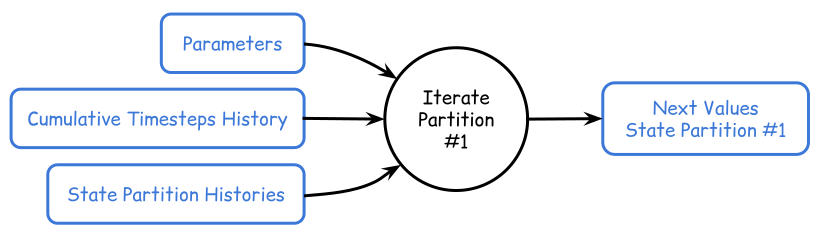
How are a partition’s next values calculated?
By a calculation chosen for that partition, which reads the simulation’s histories and the partition’s own parameters and returns its next values. To see what that calculation has to read, it helps to have an overall simulation data view: a ‘state partition histories’ structure, which is a collection of each state partition history that exists within the simulation.
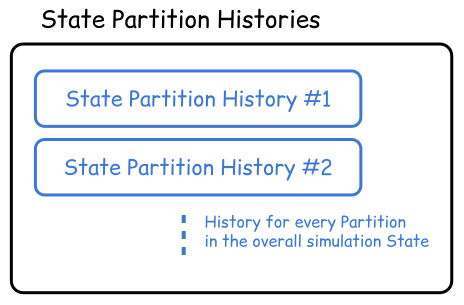
How do we determine the ‘next values’ of each state partition in time?
This is where we should maintain full flexibility in choice of calculation so that our simulation is able to represent many different real-world systems.
Each of these calculations for a given partition specifies how the state partition histories and cumulative timesteps history data are used to determine the next values of the state partition.
In order to support even more flexibility in configuration, the calculation should also take in a set of parameters which are specific to that partition.