From root: Why should I simulate the real world?
What decides when the next timestep happens?
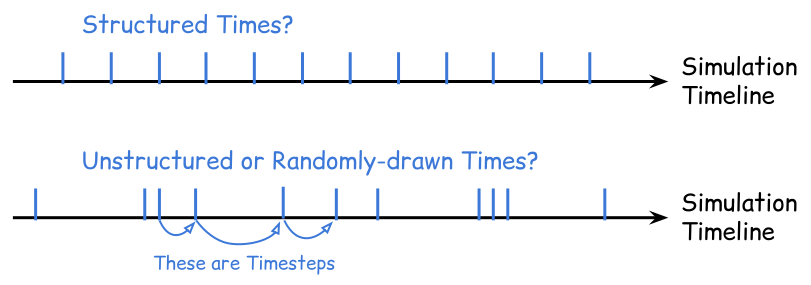
A calculation of our own choosing, which we call ‘advance time’. New states of the simulation may happen at different times, so something has to determine where those times fall along the simulation timeline.
When simulating systems in the real world, it can be desireable in some situations to be able to structure the times along the timeline at regular intervals.
In other situations it can be desirable to have an unstructured or randomly-drawn set of times along the timeline.
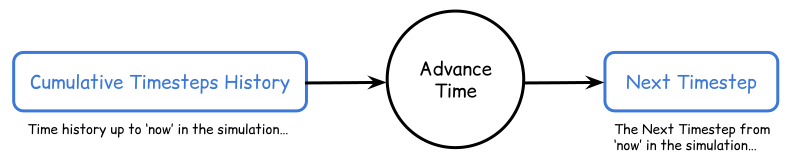
In order to allow this flexibility in choice between situations, let’s specify an ‘advance time’ calculation which takes in the current cumulative timesteps history and outputs the next timestep following the latest time found in the history (at index 0).
References and further reading
Hardwick, Robert J. 2026a. “How does a simulation keep track of time?” umbralcalculations, November. https://umbralcalc.github.io/posts/how_does_a_simulation_keep_track_of_time.html.
Hardwick, Robert J. 2026b. “Why should I simulate the real world?” umbralcalculations, May. https://umbralcalc.github.io/posts/why_should_i_simulate_the_real_world.html.
Law, Averill M., and W. David Kelton. 2014. Simulation Modeling and Analysis. 5th ed. McGraw-Hill.
Questions whose answers cite this one