Grid-scale batteries promise to balance the intermittent renewables of a net-zero electricity system: but how should they be dispatched, and does the answer change as the grid gets greener?
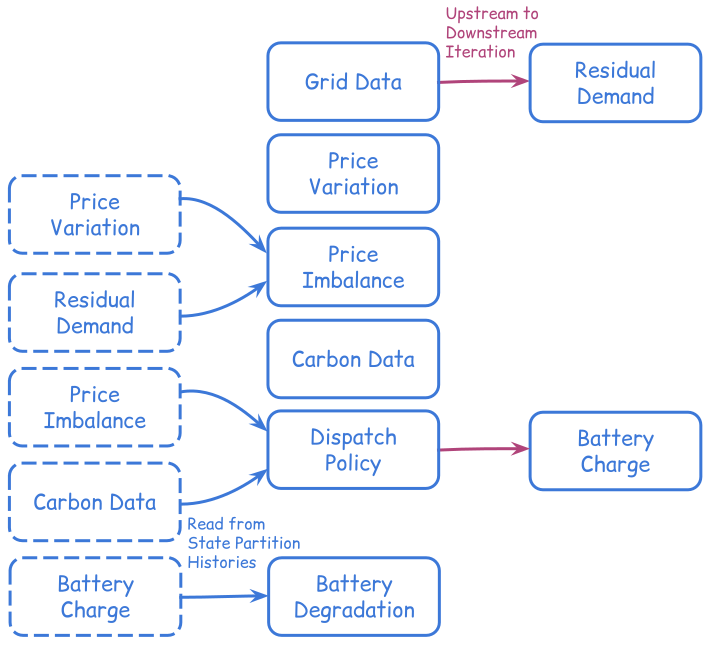
The simulation below is fitted to five years of NESO half-hourly demand data and tracks how a 100 MW / 200 MWh battery’s state of charge, revenue, and carbon savings evolve under different dispatch strategies and grid mixes.
Pick a dispatch policy, a grid scenario, and tune the price thresholds; watch how the battery’s revenue and carbon impact evolve over a year.
Albadi, Mohamed H., and Ehab F. El-Saadany. 2008.
“A Summary of Demand Response in Electricity Markets.” Electric Power Systems Research 78 (11): 1989–96.
https://doi.org/10.1016/j.epsr.2008.04.002.
Hardwick, Robert J. 2022.
“Stochadex: A Simulation Engine Written in Go.” GitHub.
https://stochadex.github.io/.
Hardwick, Robert J. 2026a.
“energy-balancer: Energy Storage Dispatch and Demand Response Optimisation.” GitHub.
https://github.com/umbralcalc/energy-balancer.
Hardwick, Robert J. 2026b.
“How can simulations help me take better actions?” umbralcalculations, May.
https://umbralcalc.github.io/posts/how_can_simulations_help_me_take_better_actions.html.
Hardwick, Robert J. 2026c.
“How does a simulation learn its parameters from data?” umbralcalculations, November.
https://umbralcalc.github.io/posts/how_does_a_simulation_learn_its_parameters_from_data.html.
Hardwick, Robert J. 2026d.
“What is a state partition?” umbralcalculations, November.
https://umbralcalc.github.io/posts/what_is_a_state_partition.html.
National Energy System Operator. n.d.-a.
“Carbon Intensity API.” National Energy System Operator.
https://carbonintensity.org.uk/.
National Energy System Operator. n.d.-b.
“NESO Data Portal.” National Energy System Operator.
https://www.neso.energy/data-portal.
Palensky, Peter, and Dietmar Dietrich. 2011.
“Demand Side Management: Demand Response, Intelligent Energy Systems, and Smart Loads.” IEEE Transactions on Industrial Informatics 7 (3): 381–88.
https://doi.org/10.1109/TII.2011.2158841.
Sheffield Solar. n.d.
“PV_Live API.” University of Sheffield.
https://www.solar.sheffield.ac.uk/api/.
Siano, Pierluigi. 2014.
“Demand Response and Smart Grids—a Survey.” Renewable and Sustainable Energy Reviews 30: 461–78.
https://doi.org/10.1016/j.rser.2013.10.022.