Antibiotic-resistant infections are rising in English hospitals: can stewardship policies bring them back down, and how much room is there to do so?
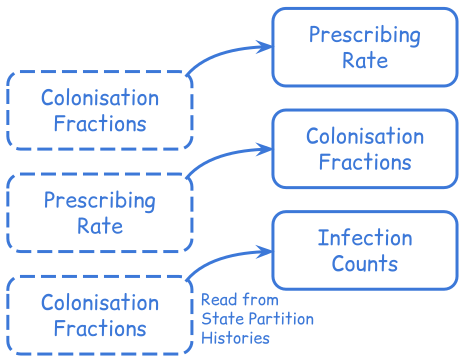
The simulation below is fitted to ten years of UKHSA surveillance data and models how cephalosporin prescribing pressure shapes the balance of susceptible and resistant E. coli inside a hospital, generating bloodstream infections as a stochastic consequence.
Pick a prescribing policy and watch how the resistance ratio and resistant infection burden evolve over time.
Austin, Daren J., and Roy M. Anderson. 1999.
“Studies of Antibiotic Resistance Within the Patient, Hospitals and the Community Using Simple Mathematical Models.” Philosophical Transactions of the Royal Society B 354 (1384): 721–38.
https://doi.org/10.1098/rstb.1999.0425.
Bergstrom, Carl T., Monique Lo, and Marc Lipsitch. 2004.
“Ecological Theory Suggests That Antimicrobial Cycling Will Not Reduce Antimicrobial Resistance in Hospitals.” Proceedings of the National Academy of Sciences 101 (36): 13285–90.
https://doi.org/10.1073/pnas.0402298101.
Hardwick, Robert J. 2022.
“Stochadex: A Simulation Engine Written in Go.” GitHub.
https://stochadex.github.io/.
Hardwick, Robert J. 2026a.
“antimicrobial-resistance: Antimicrobial Resistance Stewardship Simulation.” GitHub.
https://github.com/umbralcalc/antimicrobial-resistance.
Hardwick, Robert J. 2026b.
“How can simulations help me take better actions?” umbralcalculations, May.
https://umbralcalc.github.io/posts/how_can_simulations_help_me_take_better_actions.html.
Hardwick, Robert J. 2026c.
“How does a simulation learn its parameters from data?” umbralcalculations, November.
https://umbralcalc.github.io/posts/how_does_a_simulation_learn_its_parameters_from_data.html.
Hardwick, Robert J. 2026d.
“What is a state partition?” umbralcalculations, November.
https://umbralcalc.github.io/posts/what_is_a_state_partition.html.
Murray, Christopher J. L. et al. 2022.
“Global Burden of Bacterial Antimicrobial Resistance in 2019: A Systematic Analysis.” The Lancet 399 (10325): 629–55.
https://doi.org/10.1016/S0140-6736(21)02724-0.
The National Archives. n.d.
“Open Government Licence for Public Sector Information, Version 3.0.” The National Archives.
https://www.nationalarchives.gov.uk/doc/open-government-licence/version/3/.
UK Health Security Agency. n.d.
“Fingertips: Public Health Data.” Department of Health; Social Care.
https://fingertips.phe.org.uk/.