Why simulate real-world systems?
What can you do with simulations?
One of the most compelling uses for simulations of real-world systems is in powering decision-making technologies.
If you want to answer questions like ‘if I take this action, then what will happen in my system?’, then it is often essential to build a simulation of your system and use this to simulate what might happen in the future.
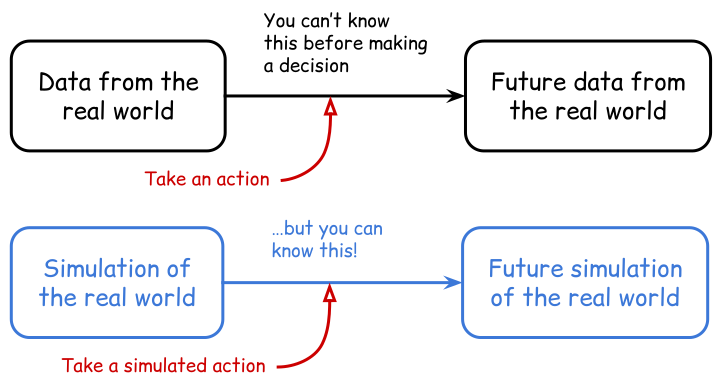
Advantages to using real-world simulations
With simulations of the real-world, in contrast to other predictive AI approaches, you can also interrogate the internal state of the system to help validate the assumptions used in making a decision.
This can be a real advantage for decision-making technologies, since human users usually need to justify their decisions through structured reasoning.
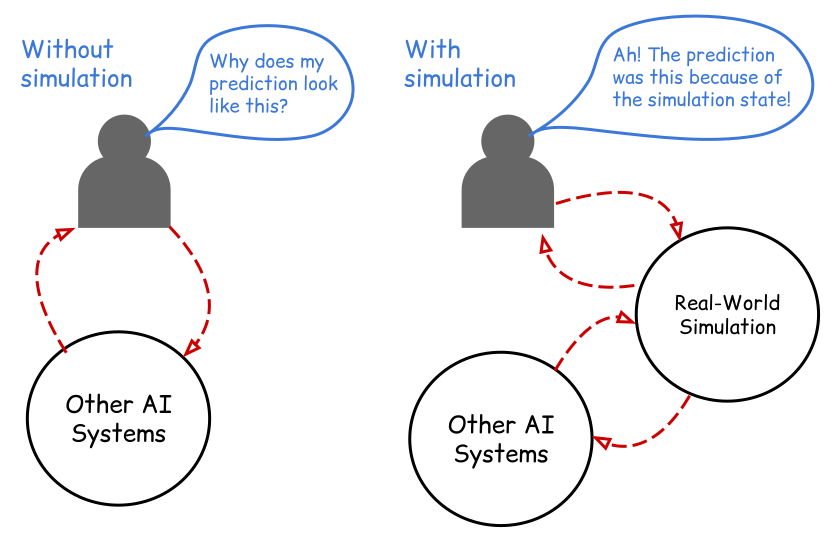
Example: Predictions only vs simulations
Prediction only
There is a forecast line, but the internal logic is hidden. If the prediction is wrong, it's difficult to interrogate why.
Simulation/mechanistic model
References and further reading
Box, George E. P. 1976. “Science and Statistics.” Journal of the American Statistical Association 71 (356): 791–99. https://doi.org/10.1080/01621459.1976.10480949.
Epstein, Joshua M. 2008. “Why Model?” Journal of Artificial Societies and Social Simulation 11 (4): 12. https://www.jasss.org/11/4/12.html.
Law, Averill M., and W. David Kelton. 2014. Simulation Modeling and Analysis. 5th ed. McGraw-Hill.
Leutbecher, Martin, and Tim N. Palmer. 2008. “Ensemble Forecasting.” Journal of Computational Physics 227 (7): 3515–39. https://doi.org/10.1016/j.jcp.2007.02.014.